Educational Objectives
▶Educational Objectives
- To cultivate talents capable of generating technological innovation for sustainable development
- To foster interdisciplinary leaders who can play a pivotal role in the energy sector through integrative education
- To achieve the educational philosophy of Problem-Based Learning (PBL), enabling students to proactively identify and solve energy-related problems
Remark: PBL = Problem-Based Learning
▶ Talent Profile
- (Problem Analysis & Definition) Individuals capable of analyzing energy systems from multiple perspectives and identifying core problems
- (Problem Solving) Creative and interdisciplinary talents who can solve energy-related problems based on integrative thinking
- (Communication & Leadership) Proactive leaders equipped with empathy, teamwork, and social responsibility to lead a sustainable future
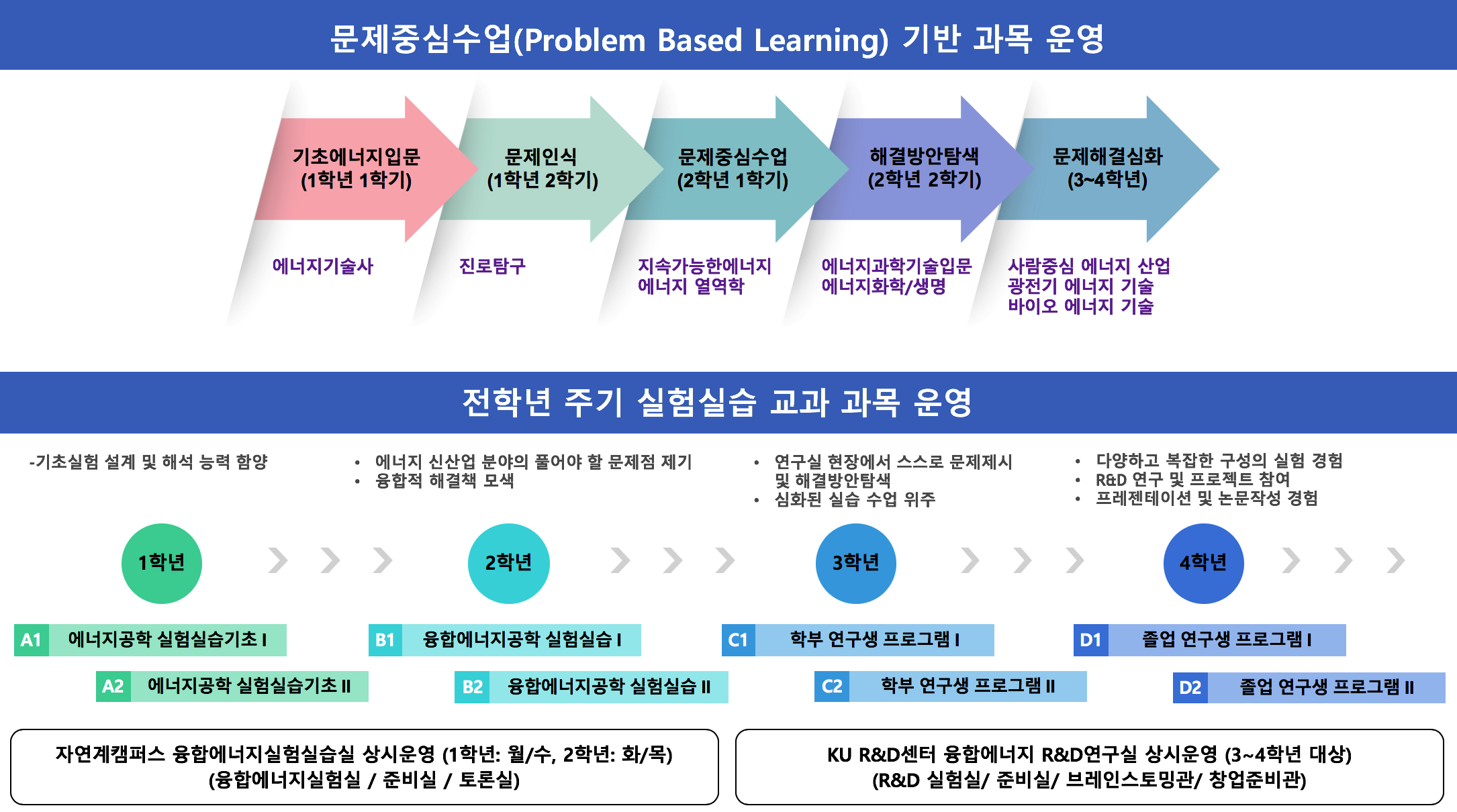
▶ Year-by-Year Goals
• Freshman Year
Students are expected to build a strong foundation in basic sciences such as general physics, chemistry, biology, and calculus.
In addition, they should learn programming languages essential for future engineers and develop a fundamental philosophy on energy and the environment, along with humanities literacy.
Building meaningful relationships with peers is also an important part of this stage.
• Sophomore Year
Students participate in collaborative experiments and practical training to develop teamwork and leadership skills.
They also enhance awareness of global energy issues and actively engage in research internship programs to cultivate a sense of community and research ethics.
• Junior Year
This is the stage where students fully develop as integrative energy engineers by applying interdisciplinary technologies to energy systems.
Students learn the latest technological trends connecting materials, devices, and applications in NT-IT-BT (Nano, Information, Bio Technologies) and explore how these technologies can be applied to energy and environmental issues.
They also gain hands-on experience through advanced experiments and practical training in energy materials and device fabrication.
Furthermore, students analyze global energy and environmental issues from an engineering perspective and learn to evaluate energy systems in economic, environmental, and socio-political contexts.
Remark: NT = Nanotechnology / IT = Information Technology / BT = Biotechnology
• Senior Year
At this stage, students complete their understanding of the integration of Energy Technology (ET) with NT-IT-BT, along with engineering problem-solving capabilities and policy awareness.
They are prepared to contribute to the sustainability of humanity and present a clear vision for their academic and professional future.
Students are now ready to demonstrate their competitiveness as integrative energy engineers in society.
Remark: This content was generated and refined with the assistance of ChatGPT.
▶ 학년별 목표
•1학년